Project goals: I mapped out business and user goals based on my research findings.
By focusing on "own words" and "mood," i am positioning the product ahead of the curve in the generative AI era.

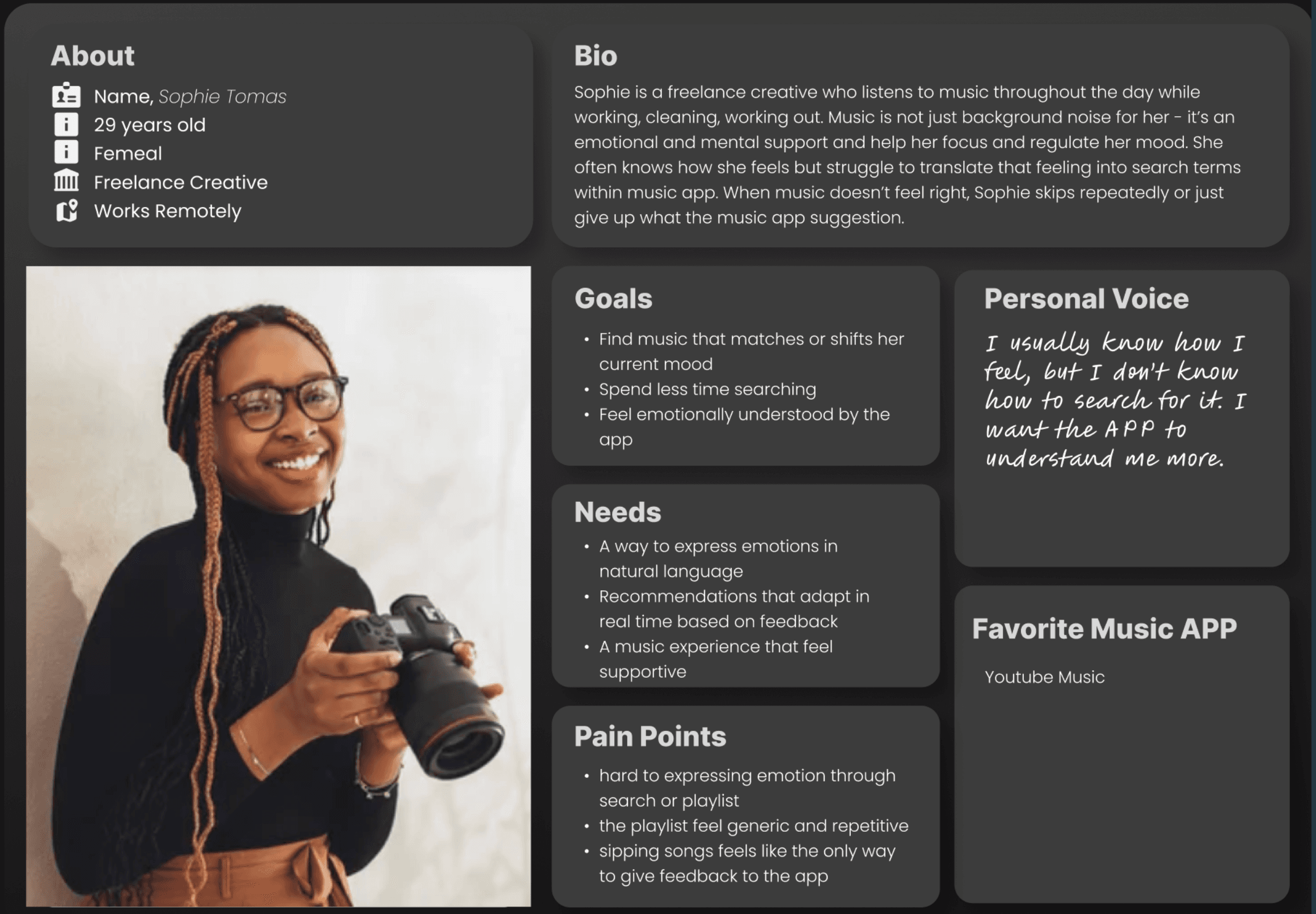
And develop my persona by capturing the insights gained
from research and communicating them in a way that is concise
for referencing during subsequent design activities.
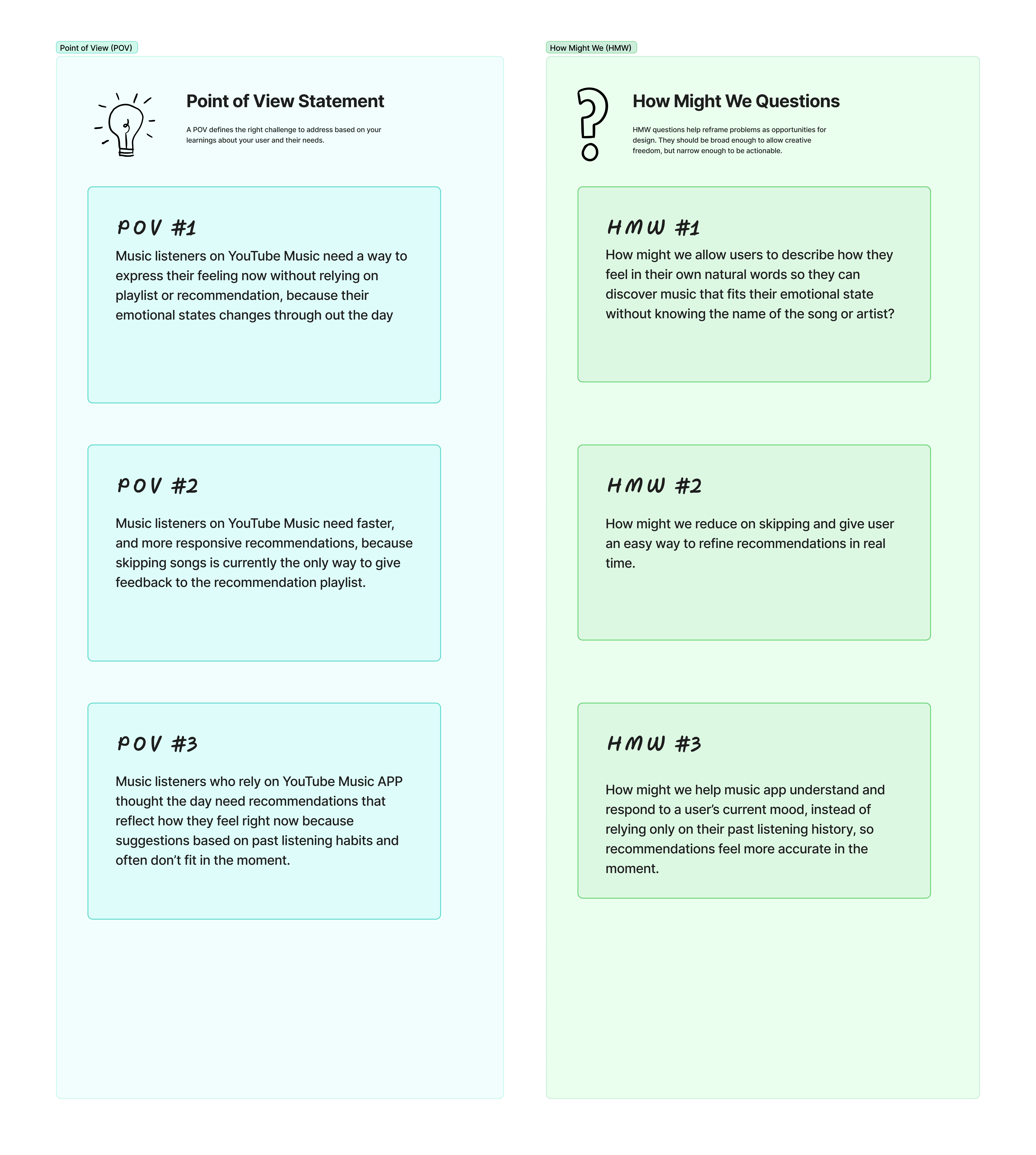
I created three problem statements
to pinpoint the user issue that needs to be solved.
Ideate and Design
Low-fidelity wireframes introduce a chatbox positioned at the top of the home screen,
enabling users to interact with an AI assistant at any time to ask questions or explore content.
Usability testing was conducted with four participants from the initial user interviews, who reviewed the low‑fidelity
wireframes and provided feedback on the proposed YouTube Music feature. Overall feedback was positive, with participants
finding the experience easy to follow, helpful, and aligned with their expectations; most were able to complete the primary task successfully,
and the user flow was perceived as logical and intuitive. Key feedback included concerns about the effort required to type moods,
with suggestions for voice input or smarter, prefilled suggestions, as well as privacy concerns around sharing emotional data,
indicating a need for clearer privacy messaging. Participants also expressed interest in receiving more recommendation options and the
ability to preview songs briefly before committing. Overall, the feature was considered easy to understand, and the feedback identified clear,
actionable opportunities for refinement.

PROJECT NAME
AI MOOD MUSIC TOOL
TOOLS
FIGMA
Year
2025
system
iOS
ABOUT THE FROJECT
Music plays a powerful role in shaping emotions, focus, and daily routines, yet discovering the right song in the right moment on YouTube Music can still feel frustrating—especially when users don’t know what to search for. Current discovery methods rely heavily on past listening behavior, which doesn’t always reflect how a user is feeling in the moment, creating a gap between emotional intent and music discovery. This project aims to bridge that gap by designing an AI-powered feature that lets users describe their mood in natural language (for example, “overstimulated but tired” or “angry but need to focus”) and receive music recommendations that feel emotionally relevant and intentional.
More projects


Research
I did competitor analysis for the top three music playing Apps on the market. Youtube music spotify and apple music.
I breakdown that clearly identifies a market gap, highlighting that none of the major players have perfected "Natural Language Mood Input".

AI MOOD TOOL
MUSIC DISCOVERY
An AI-powered music experience that turns your mood into personalized recommendations in seconds.
And to understand deeply how users currently discover music, and how they currently search for and discover music, I wrote some questions for an interview guide to explore the role mood and emotion can play in music selection.
Some question I asked are
Have you ever given up or searching and just settle for what recommendation gave you? If so, why and what makes you gave up?
Have you ever skipped multiple songs because they didn’t match what you feel at that moment? If so, what did you do?
Do you ever listen to music to change your feeling rather than match your energy at that moment?
I mapped out what user needs and goals into steps with my product to keep the flow clear



Define
After I got back the interview answers from participants, I start my research synthesis on affinity mapping.

This project demonstrated how AI can better support user’s emotional needs in music discovery by shifting the experience
from history-based recommendations to real-time, mood-driven interactions. I aimed to reduce friction and create a more responsive experience.
However, it is also important to consider relations around privacy, which are important to keep mood inputs private by default.
Throughout the process, I learned the importance of how small user behaviors, like repeated skipping can reveal deeper needs,
that's why i came up with this idea to let user clearly express what they want.
After selecting a key focus area, I defined a set of features, prioritizing those that are essential to the core experience while identifying others as potential enhancements to be introduced in future iterations.

High fidelity UI & Usability Testing
For hi-fidelity wireframes I let my 5 participants to test below 4 task:
Discover open ai-chat
Enter mood using natural language
Review recommendations
Feedback for recommendation
The main feedback to adjust was keeping the same brand style as the existing youtube music style
on playlist, color and style, so i went back to adjust.